
Acid Brass
Arranging machines
for breath and brass.
Rodney Newton and later Dr Richard Rock translated club records into music that retained their menace, melancholy and lift.
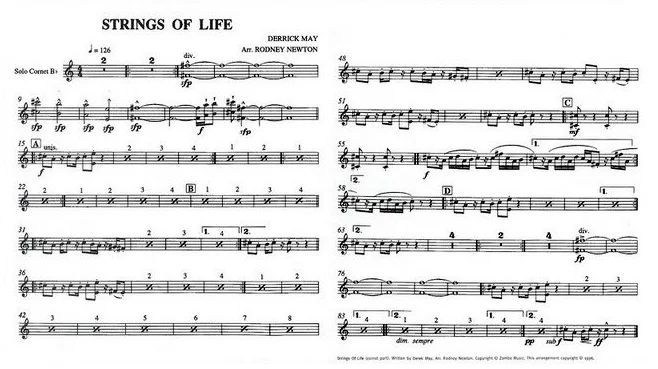
Rodney Newton arranged the original set exclusively for Fairey, recreating acid-house records for a standard brass-band line-up. In his own words, it was the most unusual project he had taken on.
“Of all the projects I have undertaken in recent years, Acid Brass has been the most unusual. My background is that of a classically trained musician with experience of both orchestral playing and composing and arranging for the concert hall, films and television. Although a peripheral interest in pop has led to the purchase of albums such as those by Genesis, The Moody Blues, Queen, Lionel Richie and Chris Isaak, house music had hitherto been for me totally uncharted territory.
“The use of brass bands in popular music is not a new thing. Peter Skellern has used bands strikingly in a number of his songs and the Brighouse and Rastrick Band had a chart hit with their arrangement of The Floral Dance. However, Acid Brass is something very different, and although intrigued by the idea, I have to say that my initial reaction was one of scepticism. When listening to the first songs Jeremy Deller had chosen I was puzzled as to how I could possibly translate this type of dance music adequately into the medium of the brass band. However, as soon as I started work I found that some things fell into place right away. For instance, the opening chords of Pacific 202 fitted comfortably on the tenor horns, baritone horns and tubas, and the busy bass riffs suited the euphoniums. The piping solo sounds in Let’s Get Brutal were given to a muted soprano cornet, and the haunting vocal lines of Voodoo Ray were shared between tenor horns and flugel horn — the latter placed some distance away from the band to create something of the atmosphere of the original.
“The clap tracks used on some of the numbers were difficult to reproduce purely in brass terms without sacrificing some of the original effect, so I decided in certain places to have the players themselves actually clapping these parts — it gave them a chance to rest their lips! Similarly, the rapping which was a feature of certain sounds presented a problem since it was pitchless, but this was overcome by giving the important solo rap phrases to the kit drummer. In the percussion lines I tried to follow the synthesised originals as closely as possible, reproducing as best I could the synthesised tracks with live instruments. I added timpani parts to What Time Is Love? and Can U Dance? to give extra impact to key phrases.
“Songs like the latter presented less of a problem since, by their nature, I was able to give them the kind of ‘big band’ treatment which always suits brass bands very well. The one really problematic piece was Voodoo Ray, since its success depends on the atmosphere created by echoing voices and the sinister chanting of its title. After giving the matter considerable thought, I decided that there was nothing for it but to get the band to do the chanting in the manner of the original. I shared the chant lines around the band to try to recreate something of the stereo effect used on Gerald Simpson’s record, and instructed the players to use low, guttural voices.
“Once the project had really come together and the pieces were in rehearsal, I was amazed by how effective many of them were. However, all of this would have gone for nothing were it not for the whole-hearted co-operation and commitment of the wonderful Fairey Band. This legendary band boasts many young players who were already familiar with this kind of music and enjoyed it greatly. Their enthusiasm spread rapidly among their older colleagues, and the whole thing took on a freshness and excitement which was evident in the way they played at one of their first Acid Brass concerts, in Liverpool. That concert proved that music is a great means of communication between age groups and cultures and, as Can U Dance? strutted its stuff before the youth of Liverpool, I could sense the barriers between the generations tumbling down in an instant. Acid Brass has managed to bring together the young and the not-so-young in a way that all the politicians and social workers could never do. Let’s have more of it!”
— Rodney Newton, arranger
The later Acid Brass 2 — In Yer Face set was arranged by Dr Richard Rock, moving towards a harder-edged sound while retaining the technical mastery of the band.